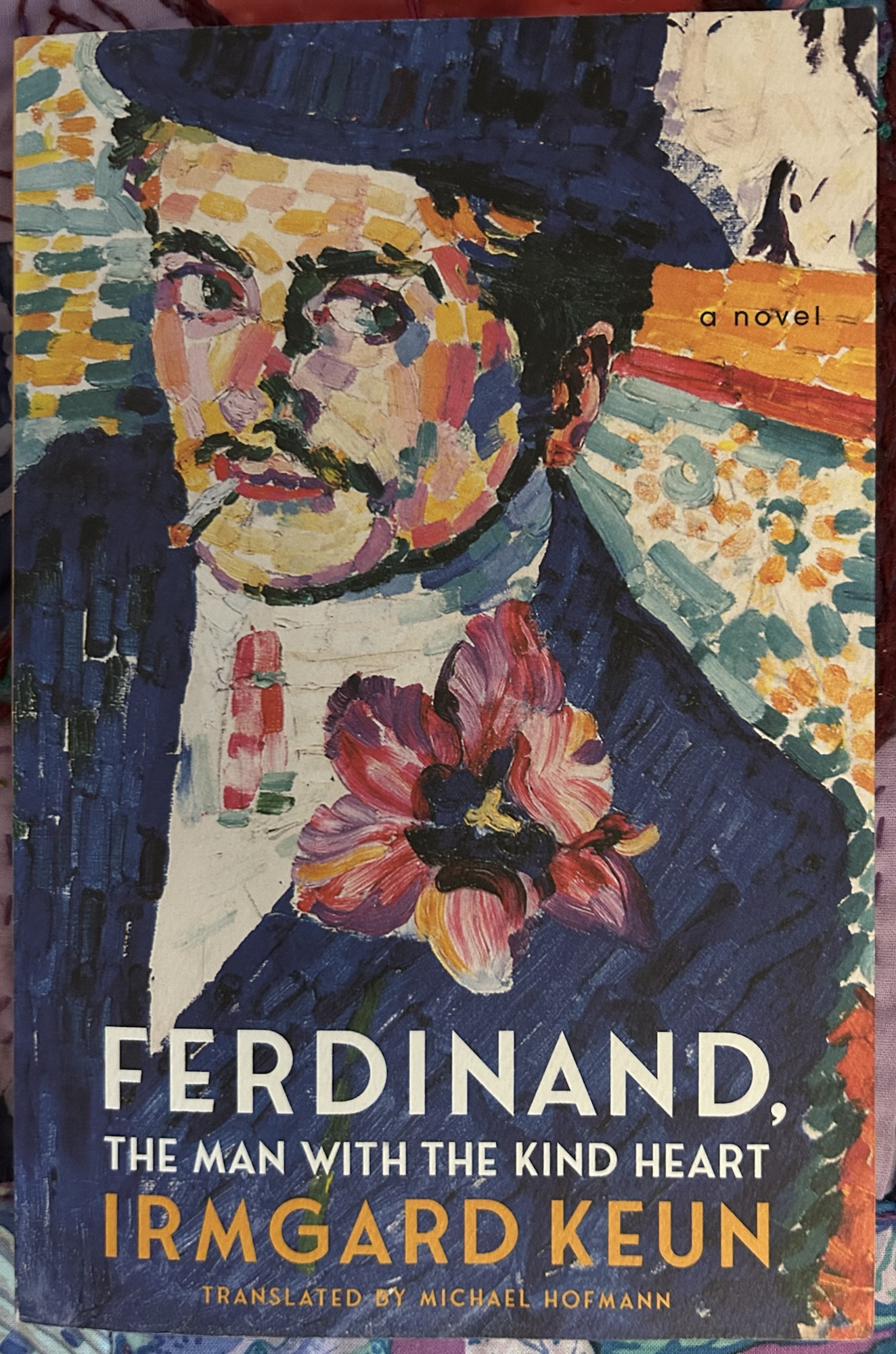
I really enjoyed my first experience of Irmgard Keun when I read Child of All Nations last year, and so I was looking forward to picking her up again. Women in Translation Month provided the perfect opportunity. Ferdinand, The Man With the Kind Heart (1950, transl. Michael Hoffman 2020) was her final novel, written not long after the end of World War Two, and just a year after the division of Germany. (There is some dated language in the novel).
The story is told from the point of view of titular Ferdinand as he somewhat listlessly makes his way around war-torn Köln (Cologne). The privations continue and the illicit economy thrives. Keun is so witty and gives her narrator an inventive turn of phrase:
“The Moselle tastes as flaccid and murky as the decayed philanthropy of an unhappily married vintner. The Belgian cigarettes taste of rancid hay.”
His landlady Frau Stabhorn is thriving in her own way, renting her hallway to him as a room, making jam to sell and caring for her grandchildren. Ferdinand’s experience of this brood is expressed with a degree of tolerant irony:
“Children are the bonny little blossoms in the mouldering garden of life. As I write, a couple of the bonny little blossoms are trying to spread a mixture of jam and plaster of paris all over my arms and legs.”
The book is really a series of portraits, with the plot mainly existing as the passage of time. We meet fellow lodgers:
“Lily is the victim of her beautiful feet. She studies chemistry and earns money on the side from knitting sweaters and writing.”
And poverty-stricken Ferdinand is later employed by a snake-oil salesman:
“Liebezhl draws horoscopes, reads palms, swings crystals, lays cards, sells amulets, and does a little podiatry.”
Who offers him work as a sort of agony uncle:
“Waiting for me outside my office I had, among others, a man with broken fingernails, a wine grower who wanted to get married for the fourth time … five deserted wives, and a sixth who wished to be deserted because her husband snored. I had my work cut out for me.”
Meanwhile, Ferdinand is trying to work out how to get out of his engagement, again observed with a certain ironic detachment:
“There are three items that Luise managed to hang onto throughout the war: a stove, an electric iron, and me. All three of us are a little impaired, and not quite good as new. But Luise is hanging tenaciously, not to say grimly, on to all of us. Her favourite is the stove, and next, even ahead of the iron, is me.”
So, there is a lot of humour in Ferdinand, but there are some very serious points that Keun makes too. And in fact I found the listless, plotless, artless quality to the character and the story to be a serious point too. Ferdinand was a solder and a prisoner of war. To me, his narrative style, his detachment, numbness, ironical distancing, lack of real interest in anything, was a portrait of trauma.
He doesn’t dwell on his past, but when mentioned it is striking:
“My only feeling was fear. I was swimming in an ocean of fear… I was afraid of the NCOs, headquarters, uniforms, barracks, corporals, the officers’ voices—the whole massive machinery of it.
I no longer saw human beings, all I saw were the mechanical manifestations of a force that hypnotised me to the point of crippling despair.”
There is also disgust and cynicism regarding former Nazis living their daily lives, such as Luise’s father:
“He settled down among the spoils of his wife and pouted. His wife and daughter waited on him, the household was his to command, and gradually he clambered back up to the temporarily vacant throne of the family dictator, and everyone tried to be as satisfied and dissatisfied as they’d been previously, in the good old days.”
And sadly of course, his observations have not dated, although specifics change:
“Dictatorships are always very strict about what they understand as morals and public ethics. Our former unlimited German dictatorship has, in the way of lower life forms, procreated by simple fission, and is now called democracy.”
All in all, I found Ferdinand an intriguing read. There was a sense at the end that despite being the titular character and first-person narrator, he had slipped through my fingers. But as I thought about how this was the point, I found this very affecting. Cologne and its citizens were in a process of recovery, trying to understand what remained and how to live after devastation (60% of the city was bombed). As an exploration of the aftermath of war on individuals and on society, it was skilled, subtle and truly moving.
“There are people to whom the whole world is a toy, and who love it and take it as seriously and carefully as they take their toys.”


I’ll be passing through Cologne again on a railway holiday in October. Perhaps I should take this one with me.
LikeLiked by 1 person
Oh interesting! I looked at footage on YouTube of how it was after the war and it was absolutely destroyed. Keun is portraying a city that is thankfully unrecognisable now. I had to follow up with travel videos of modern day Cologne to cheer myself up. I hope you have a lovely holiday!
LikeLiked by 1 person
Thank you! It’s astonishing that the cathedral survived although it was hit many times.
LikeLiked by 1 person
I remember being really struck by Cologne when I visited it in 1992. Even though it was a warm day, the dark stone imposing cathedral cast a haunting chill over the city.
I didn’t know about this book, although I was aware of some of Keun’s work. I do like the sound of this one very much indeed. On the list it goes! I have had so much inspiration from WIT month that my piles of books in translation will keep me going to Christmas at this rate!
LikeLiked by 1 person
The cathedral really stands out doesn’t it? Even amongst the rebuilding.
This is an unusual book I think, enigmatic in both plot and central character! But if you don’t mind those things I found it very moving.
WITMonth and NovNov are especially terrible for the TBR I find… but it’s a nice problem to have!
LikeLike
One for my list, the quotes you’ve chosen make this sound a very interesting read; I only know cologne from it’s station which I thought fabulous!
LikeLiked by 1 person
I hope you enjoy it Jane! I’ve just googled the station and it does look fabulous indeed!
LikeLiked by 1 person
Not for me, I think, but I do love the cover! Is that original artwork, do you know, or is it a reproduction of a painting?
LikeLiked by 1 person
It’s lovely isn’t it? It’s a detail from Man with a Tulip (also known as Portrait of Jean Metzinger) by Robert Delaunay.
LikeLiked by 1 person
Thanks! An artist completely unknown to me, but on checking him out, I like his stuff – it has wall-hangability!
LikeLiked by 1 person
I love the sound of this Madame B – I’ve read a number of Keun’s books but not this one, and I’ll definitely have to track it down. She writes so well!
LikeLiked by 1 person
She really does! I hope you enjoy this one Kaggsy.
LikeLiked by 1 person
I think this is probably Keun’s weakest novel – and possibly the only one featuring a male protagonist? – but it’s not with merit. Her portrayal of post-war Cologne feels very evocative and realistic, and as always with Keun, it’s very well written. The quote beginning with ““My only feeling was fear…” is very powerful…
LikeLiked by 1 person
I really liked it, despite the plotless quality. I still haven’t read The Artificial Silk Girl or Gigli which I’m really looking forward to.
LikeLike
I love those quotes – quite the bons mots! I enjoyed but didn’t love The Artificial Silk Girl, so I was surprised that Jacqui thought it her weakest novel – 😀
LikeLiked by 1 person
Glad you enjoyed the quotes! There was so much I thought quotable in this book 😊
That’s interesting to hear how you got on with The Artificial Silk Girl, I’m looking forward to seeing how I find it!
LikeLiked by 1 person
Just realised my comment read wrongly. Jacqui said Ferdinand was her weakest, not Silk Girl!
LikeLiked by 1 person
An author I would definitely like to explore! (I love that oven and iron comment. /snortylaugh)
LikeLiked by 1 person
I definitely want to read more by her too! There were a lot of witty lines in this 😁
LikeLike