It was Claire at Word by Word whose blog post last year alerted me to All That Remains by Virginie Grimaldi (2022, transl. Hildegarde Serle 2025). This story of inter-generational friendship was so appealing, and it turned out to be a lovely read for Women in Translation Month 2026.
Jeanne’s husband of many years has died, leaving her spiralling through the disorientation of immense grief. Each day she visits him:
“That was her husband’s habit, cluttering up his stories with superfluous details. How often had she switched off while he was talking to her? Jeanne’s parents had taught her only to open her mouth when it was strictly necessary. And here she was, at seventy-four, telling a gravestone about the TV programme on the dangers of sugar that she’d watched yesterday.”
At the bakery near her house, eighteen-year-old Théo is an apprentice baker. Each chapter is headed with one of three character’s names and told from their point of view. I loved Théo’s voice, so bolshy and insecure. He goes to a karate class each week and tries to partner with younger boy Sam, who is still better than him at the martial art. One day his teacher takes charge of the pairs:
“Laurent, a guy who’s two heads taller than me and has shoulders I could do the splits on. Only the fenders are missing to mistake him for a 4×4. He’s not a man, he’s scaffolding. A wardrobe with feet and arms. But a large wardrobe, right, the sort Beyoncé would have.”
When Jeanne realises she needs to do something drastic or she risks losing the home she had with Pierre, she takes in lodgers. And so she ends up sharing her apartment with Théo and thirty-three year-old Iris.
At first Iris and Théo butt against each other almost like siblings:
“I left home at the same time as Theo, who is always as pleasant as a pap smear. From the very top step, I sensed I wasn’t going to reach the ground floor in a vertical position. My foot slipped without asking my permission, the rest of my body didn’t have time to register the information, it fell limply.”
But gradually the three of them feel-out how to live together. At first it is logistical adaptation, around meal times and use of the bathroom. Théo takes on Jeanne’s lack of housekeeping:
“I’ve seen some right messes, but on this scale, never. Every time I open a drawer, it looks like burglars have rifled through it. You’d never think it, entering the apartment … But don’t open the cupboard, unless you want your brow busted by a Breton bol.”
While Iris overcomes her apathy to Boudine, Jeanne’s dog.
Then slowly, they start to become friends. Watching the relationships grow between the three is undoubtedly feel-good, without being sentimental. All have secrets: Jeanne is seeing a psychic and receiving strange letters; Théo has left the children’s home where he largely grew up but has found his troubled past less easy to shake; and Iris is skulking around the city, working as a carer although she loved her vocation as a physiotherapist – why?
Together they learn all that friendship can offer, from the most surprising people in the most unlooked-for places. I found it genuinely moving, a comfort read without being saccharine or fantastical. A major contrivance occurs at the end but by that time I was so won over I couldn’t have cared less.
“My mother always preferred people with flaws to those without. She’d often say that two smooth surfaces slide over each other, whereas two dented surfaces catch on to each other and become stronger together. She wasn’t always wrong.”
Happy Colette’s birthday! Regular readers will know how much I love Colette, and today I thought I’d look at two of her novellas which I had languishing in the TBR, La Vagabonde (The Vagabond) and L’Entrave (The Captive). Both follow periods in the life of Renée Néré, based on Colette’s experiences after her marriage to Willy ended.
Renée has left her philandering husband Adolphe Taillandy and has no regrets about doing so. However, this has left her with no money, and so she has turned from her beloved writing to earn money on the stage.
“I had savoured the voluptuous pleasure of writing, the patient struggling with the phrase until it becomes supple and finally settles down, curled up like a tamed animal, the motionless lying in wait for a word by which in the end one ensnares it.”
She is in her early thirties, and painfully aware of aging in an industry that depends on appearance and artifice. Renée has a “face which is losing the habit of being looked at in daylight” and which poverty will not help. She enjoys the stage though, and the people in it.
“They swagger, tightly buttoned in a full-skirted overcoat of the fashion of two seasons ago; for the essential, the indispensable thing, is the possession not of a clean suit but of a ‘really classy’ overcoat which covers everything: threadbare waistcoat, shapeless jacket, trousers yellowed at the knees; a dashing, flashy overcoat, which makes an impression on the director or the agent, and which in the last resort enables one to throw off that ‘things aren’t shaping well’ in the jaunty tone of a man of means.”
Colette is not sentimental about the poverty or hardships of such a life. Early on she writes of the gradual but inevitable degradation of young chanteuse Jadin, in a way that is clear-sighted but heartbreaking.
Into Renée’s world comes Maxime Dufferein-Chautel, a rich feckless admirer. What follows is a love affair of sorts, one in which Renée never quite resolves her ambivalence.
“He does not want my well-being, this man, he merely wants me.”
“There are days when solitude, for someone of my age, is a heady wine which intoxicates you with freedom, others when it is a bitter tonic, and still others when it is a poison which makes you beat your head against the wall.”
Maxime is not unpleasant or abusive, but he is pretty dull:
“I forgive him all this ordinariness for the sake of a simplicity which has nothing humble about it, and because he finds nothing to say about himself.”
And Renée is painfully aware that getting into a relationship with him may require more than she is willing to give. As her friend Hamond points out:
“Be frank, Renée, be clear sighted, and tell me whether all your sacrifices [within marriage] haven’t only lost their value in your eyes since you recovered your free will? You assess them at their true worth now that you no longer love.”
Renée is offered a tour and vacillates about whether to go. Ultimately she does and her letters to Maxime form the latter part of the novella, although we never see Maxime’s replies. The Vagabond is determinedly Renée’s story and her voice.
“This evening I should not feel sleepy, and the spell of a book – even a brand new book with that smell of printers ink and paper fresh from the press that makes you think of coal and trains and departures! – even that spell will not be able to distract me from myself.”
Despite The Vagabond’s various urban settings, there is still plenty for fans of Colette’s depictions of the natural world to enjoy, such as this description of early Spring in Paris:
“Towards the end of the afternoon, a mauve mist veils the avenues so that you do not know where they end, and the unexpected discovery of a wild hyacinth, with its three slender bells of artless blue swaying in the wind, has all the charm of a stolen joy.”
The Vagabond is slightly plotted with very little happening. It is not a slight tale though, but rather a distinctive plea for female independence alongside a consideration of how to reconcile this with romantic love and material necessity.
“Are you not he who, thinking he is giving, takes for himself? You came to share my life. To share, yes: to take your share!”
The Captive (1913, transl. Antonia White 1964) is set three years later. Renée is now financially solvent due to a legacy and whiling away her time in the south of France. She is still living the itinerant hotel-based life, unable to fully adjust to her new circumstances: “when a dog has been kept a long time on a lead, it does not go prancing off the moment you undo the catch of its chain”.
She finds herself with an unlikely trio of friends. There is young May, self-mythologising and fragile:
“Nature has drawn all the features of laughter itself in her round childish face; a Cupid’s bow mouth that tilts up at the corners like her mischievous eyes, a short little nose with quivering nostrils. But gaiety is not a perpetual fidgeting that betrays a lack of security, it is not chatter full of recriminations, nor is it a craving for everything that intoxicates. Gaiety, it seems to me, is something calmer, something healthier, something more serious.”
There is also May’s brutish lover Jean, and their friend, the opium-addicted Masseau.
“Yes, I’ve had enough of those people, it’s true. But, besides beginning to know myself, I’m also beginning to know the advantages and disadvantages of this extraordinary part of the world where mornings are enchanting and the nights, however starry, make one shiver in the discomfort of a double climate. Here cold nights are not invigorating and warm nights throb with fever rather than with passion.”
At the beginning of the novel Renée is determined to remain celibate. However, for reasons that entirely escaped this reader, she is attracted to Jean.
“A kiss, and everything becomes simple and enjoyable and superficial – and also a trifle coarse.”
She leaves Nice for Geneva to try and resist him, but they are eventually reunited. Their affair is wholly unsatisfactory for both of them. Colette explores the experience of a relationship based on sexual attraction without emotional intimacy, when the latter is also desired by both but remains elusive.
“I have insulted this lover, out there alone in the soft spring night, restoring his own identity; I have insulted him by giving him my body and supposing that this was enough. He has returned the insult.”
Like The Vagabond, it is Renée’s thoughts and experiences that the reader is privy to. We know very little about Jean and even less about what he thinks and feels. While he is not likeable, the portrayal of the affair is quite even-handed, as Renée acknowledges how little she is able to give of herself. What she does give may be as much a performance as any she made on the stage:
“You pretend to love me, you do love me. Every minute your love creates a woman better and more beautiful than myself whom you forced me to resemble.”
Somehow I didn’t find The Captive too depressing, although I’m not entirely sure why. There is something resilient about Renée even when she seems to be taking such sad decisions. Although she is adrift at this point in her life, I felt there was some hope she’d start to feel more anchored within herself soon.
“The darkness is ebbing. A faint wind stirs the trees, bringing a green smell of trampled grass. Behind the plane trees, the mound of the fortifications is emerging from the dusk and the sky is taking on the colour of a field of blue flax the subdued, slightly grey, slightly melancholy tint over summer dawn over Paris.”
To end, I was looking for archive footage from Folies Bergère to reflect Renée’s career, which led me to loads of cabaret footage, which led me to loads of Cabaret footage, which led me to this performance by Liza Minelli. Basically all roads lead to Liza 😀 I’ll never not be astonished by how the chair doesn’t move until she wants it to – the woman must have abs of steel:
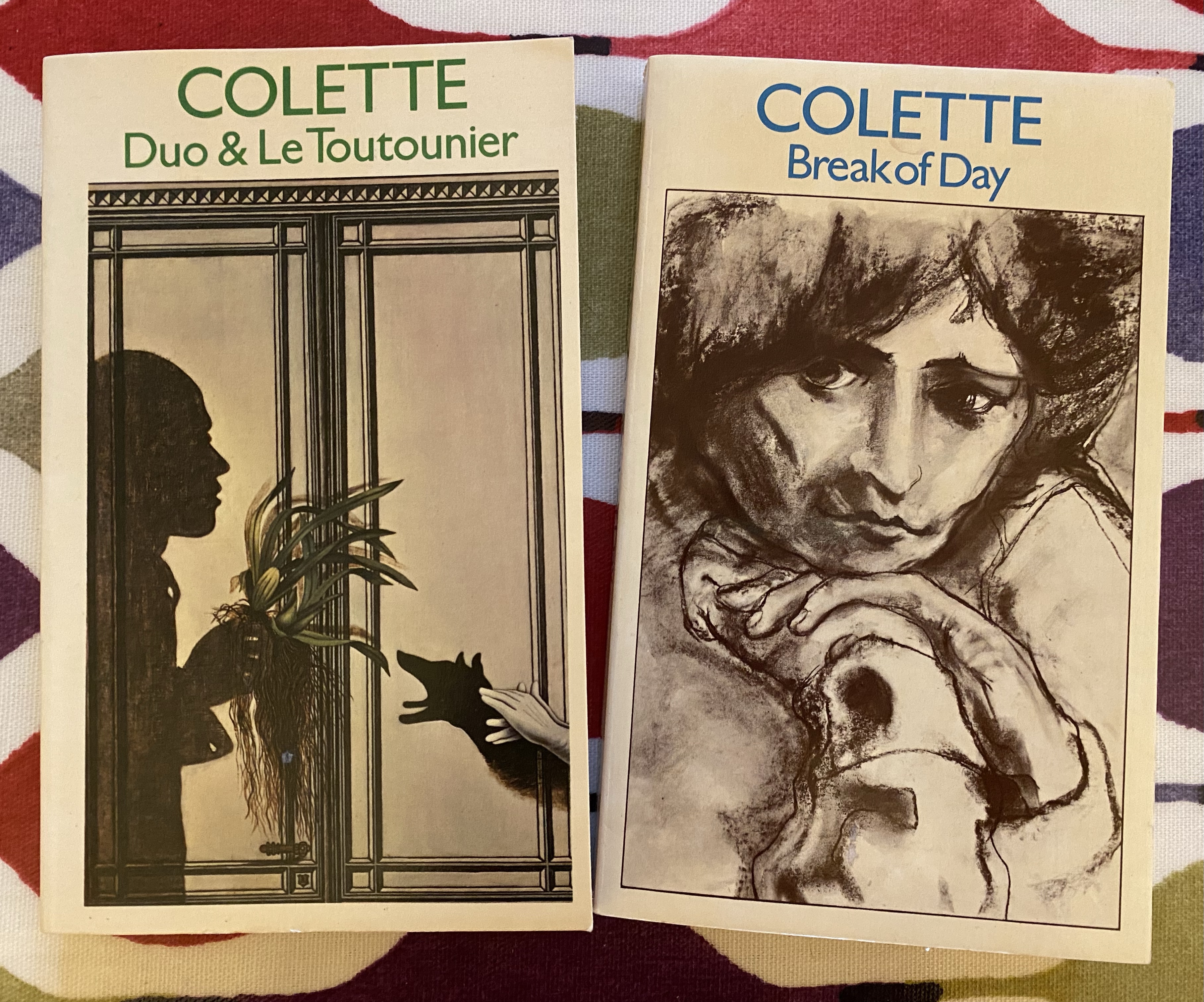
Mallika’s annual Book and Author Anniversaries post alerted me to the fact that today is the 150th anniversary of Colette’s birthday, and the perfect prompt for me to get two of her books out of the TBR (in Women’s Press editions which pleases me – how I regret clearing out loads of my The Women’s Press books when I was trying to streamline before a move one time. Never get rid of books kids – better to die under a toppling pile than live with regret 😉 )
Firstly, Duo and it’s short sequel Le Toutounier (1934 & 1939; trans. Margaret Crosland 1974). Duo follows the discovery by Michel and immediate aftermath of his wife Alice’s short-lived affair with a colleague. They are on holiday in the south of France, somewhat isolated and under the watchful eye of Michel’s family retainer Maria. The novel is primarily dialogue between the couple as they try and decide what remains for them.
Colette’s love of the natural world is very much in evidence as she captures their holiday home and Alice’s feelings of suffocation:
“On the poplars the golden bronze of the new leaves still wrongfully occupied the place of the green. A crabapple tree, its white petals lined with bright red, had defeated the somewhat sickly Judas tree and the syringas in their attempt to escape the destructive shade of the shiny aucubas, extended their slender branches and their butter white stars through the broad grasping leaves, which were mottled like snakes.”
Her precise descriptions of people and their mannerisms also suit this tale especially well, expertly capturing the tension and careful watchfulness between two people fearful of their disintegrating relationship.
“He caressed her with a few crude words, which she heard with a quiver of her eyelashes, as though he had shaken a bunch of flowers over her. They both accepted these exchanges, which were caused by chance, travel, a sudden change of season.”
Michel and Alice don’t tear each other apart, but at the same time their relationship seems doomed. However, the precision and containment of the story to a few days in a specific place, doesn’t make for a heavy or oppressive read. Colette’s humour is always present, with some surprising phrases:
“Out of modesty the servant placed a saucepan lid over the milk.”
During Duo, we learn something of Alice’s family, her sisters Colombe, Hermine and Bizoute.
“When I think about my family as much as that, it’s because I’m finding Michel terribly boring.”
In Le Toutounier she visits their stuffy, smoke-filled Paris apartment with the titular “huge, indestructible sofa of English origin, battered down like a forest road in the rainy season.”
It’s a short novel (80 pages) and I can see why it was put in the same volume as Duo as I think it is best read following on from its predecessor, forming a portrait of an interlude in Alice’s life.
Bizoute is away from home, leaving Colombe and Hermine together with their complicated love lives. Neither of them are with available men and the situation escalates. But the focus in Le Toutounier is not on relationships between the sexes but rather between the sisters, and what it means for women in a family to be close to one another. As so often, Colette focuses her sensual descriptions on women, showing appreciation but not sentimentality:
“The fine woollen dressing gown with a pattern of embossed stitching fell over her quivering shoulders, and it’s pink glow rose to her cheeks, where the makeup had lost its delicate morning colour beneath successive layers of powder.”
Secondly, Break of Day (1928, trans. Enid McLeod 1949) which nowadays would probably be called autofiction, occupying a place between biography and outright fiction. ‘Colette’ spends the summer in Provence, contemplating her past and wondering about the future. All her preoccupations are here – the natural world, animals:
“After dinner I mustn’t forget to irrigate the little runnels that surround the melons, and to water by hand the balsams, phlox and dahlias, and the young tangerine trees, which haven’t yet got roots long enough to drink unaided in the depths of the earth, or strength to break into leaf without help, under the steady scorching of the heavens. The young tangerine trees, planted … for whom? I don’t know. Perhaps for me. The cats will spring sideways at the months when by ten the air is blue as a morning glory. The pair of Japanese hens, perching drowsily on the arm of a rustic arm chair, will chirp like birds in a nest. The dogs, already far away from this world, will be thinking of the coming dawn, and I shall have the choice of a book, bed, or the coast road”
Men and women:
“My true friends have always given me that supreme proof of devotion, a spontaneous aversion for the man I loved.”
“When a man’s glance is following certain household preparations, especially those for a meal, there is apt to be a look on his face that combines religious attention, boredom and fear.”
Her mother:
“On an autumn morning she was the first and only one to see herself reflected in the first disc of ephemeral ice in the well bucket, before her nail cracked it.”
“She would, alas, have judged us plainly, with that divine cruelty of hers which was innocent of wrath.”
Break of Day is fairly plotless save for a slight drama with two young people, but not quite stream of consciousness either, written in a more structured style. If you enjoy Colette’s writing then this is a little gem, but definitely not one to read when you want to be pulled along by a cracking yarn.
Overall the sense is of Colette (author/character) coming to terms with the last part of her life, with aging and with what remains. It isn’t sad but it has a melancholy quality, although I sensed few regrets and an acceptance of how her life had been lived so far and how it would continue.
“Everything is much as it was in the first years of my life, and little by little I recognised the road back.”
I loved all of these reads. It’s been a while since I picked up Colette and I wondered why I’d left it so long. She’s funny, incisive, precise, sensual, and absolutely in command of her own voice. There’s no-one like her.
To end, a 1970s performance to match my 1970s editions, about the breaking of day: