I dithered a bit about posting on Miss Pym Disposes by Josephine Tey (1946) as although I enjoyed it, I wasn’t really sure if I could recommend it onwards. It’s an unusual novel written by an established author of the era of golden age detectives, where the murder doesn’t take place until page 157 of 208. There’s also a lot of dated stereotyping and language so do bear that in mind if you decide to pick it up.
My edition is from what I think of as the golden age of soft-focus cheese from the Penguin art department, circa mid 1970s-1980s.
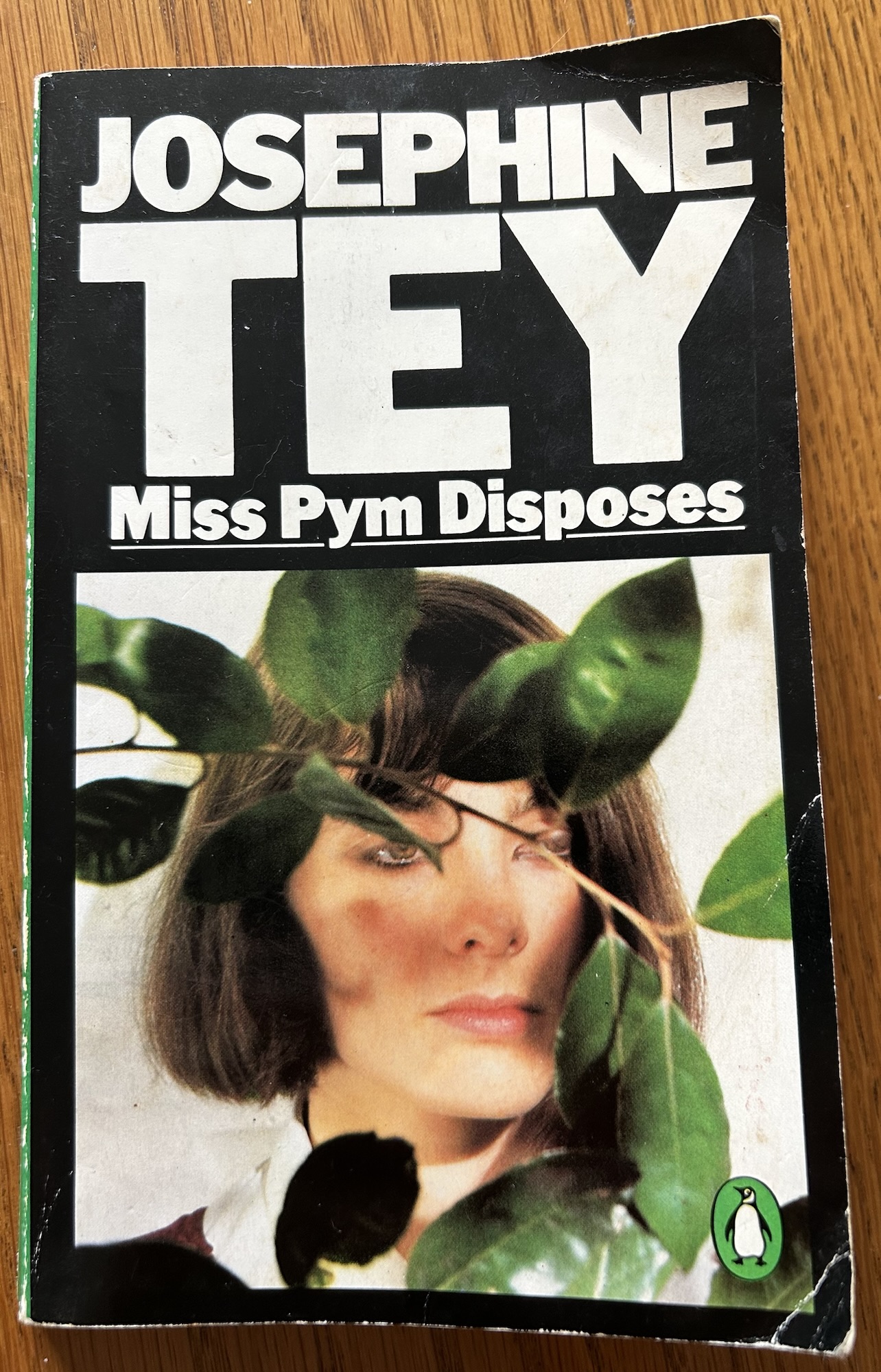
But it’s perfect for #SpinsterSeptember hosted by @pearjelly, set as it is in Leys Physical Training College for young ladies, where the teachers are single women, and with a titular character who is also a spinster. Lucy Pym initially works as a French teacher:
“But after four years of that her remaining parent had died, leaving her two hundred and fifty pounds a year, and Lucy had dried her eyes with one hand and given in her resignation with the other.
[…]
She read her first book on psychology out of curiosity, because it seemed to her an interesting sort of thing; and she read all the rest to see if they were just as silly. By the time she had read thirty-seven books on the subject, she had evolved ideas of her own on psychology; at variance, of course, with all thirty-seven volumes read to date. In fact, the thirty-seven volumes seemed to her so idiotic and made her so angry that she sat down there and then and wrote reams of refutal. Since one cannot talk about psychology in anything but jargon, there being no English for most of it, the reams of refutal read very learnedly indeed.”
I did enjoy Tey’s humour around Lucy leaving her job! Clearly she was highly sceptical of psychology though, which is quite surprising given that in many ways this is a psychological study. Much of the novel is spent building her cast of characters and the insular environment of the college.
“College was a bright gateway to the future for deserving youth; and if one or two found the gateway a hazard rather than an opening, then it was unfortunate but no reflection on the builders of the gateway.
“Like a convent,” Nash had said yesterday morning. “No time to think of an outside world.” That was true. She had watched a day’s routine go by. She had also seen the students’ two daily papers lying unopened in the common-room last night as they went in to supper. But a nunnery, if it was a narrow world, was also a placid one. Uncompetitive. Assured. There was nothing of the nunnery about this over-anxious, wildly strenuous life. Only the self-absorption was the same; the narrowness.”
Lucy is there because she was asked by old schoolfriend Henrietta to give a talk, and at first the 5.30am bell ringing and horrific institutional food means she plans to leave as soon as possible. But gradually she begins to enjoy herself, and decides to stay for the end of term gymnastic demo. She enjoys the company of the senior girls, including charismatic head girl Pamela ‘Beau’ Nash; her best friend, the accomplished but self-effacing Mary Innes; and Teresa Desterro who is there to study dance only and hone her considerable talent. There is also Barbara Rouse, who people are wary of although it’s not clear why, and is the favourite of the headmistress, also for reasons unclear.
“In the last few years [Lucy] had been ignored, envied, admired, kow-towed to, and cultivated; but warm, personal liking was something she had not had since the Lower Fourth said goodbye to her, with a home-made pen-wiper and a speech by Gladys Someone-or-other, shortly after her legacy. To stay in this atmosphere of youth, of liking, of warmth, she was willing to overlook for a space the bells, the beans, and the bathrooms.”
The girls are waiting to find out which jobs have been found for them by their headmistress, and there’s a shock when the plum job at “Arlinghurst. The school for girls, of course. A sort of female Eton.” goes to an unexpected candidate.
So, someone gets killed, and Lucy uses, I would say, one and a half pieces of flimsy evidence to work out who did it. But actually, I don’t think the puzzle element is of particular interest to Tey. There’s a great Backlisted podcast episode on this novel from back in 2021, with Val McDermid who is really enthusiastic about Miss Pym Disposes. She argues Tey is more interested in morality; the motivations of it and the conundrums around it, and I think she’s right. The reasons I find golden age detective novels a comfort read – a puzzle worked out neatly, justice and order restored – are not present here. The ending is really quite stark, and readers are unlikely to find the outcome reassuring although it is believable.
I do recommend Miss Pym Disposes, but surprisingly, not as one to be read when you’re in the mood for a golden age mystery!
To end, initially nothing sprung to mind for a suitable song, before I realised that because Teresa is Brazilian, I could include a legendary musician from that country, Caetano Veloso:


I started one of Tey’s novels a while back and couldn’t get into it at all.
LikeLiked by 1 person
She’s absolutely an unusual writer, she doesn’t meet the expectations I have for golden age crime at all.
LikeLiked by 1 person
It’s a very odd cover. I love your ‘golden age of soft focus cheese’ although Penguin probably won’t be talking it up anytime soon!
LikeLiked by 1 person
Haha! They made some very strange cover choices in that period!
LikeLike