Earlier this year Marcie and I decided to buddy read Olivia Manning’s Balkan trilogy, with The Great Fortune (1960) in June, The Spoilt City (1962) in August, and finishing with Friends and Heroes (1965) in October. I’ve just managed to get the final volume read in time!
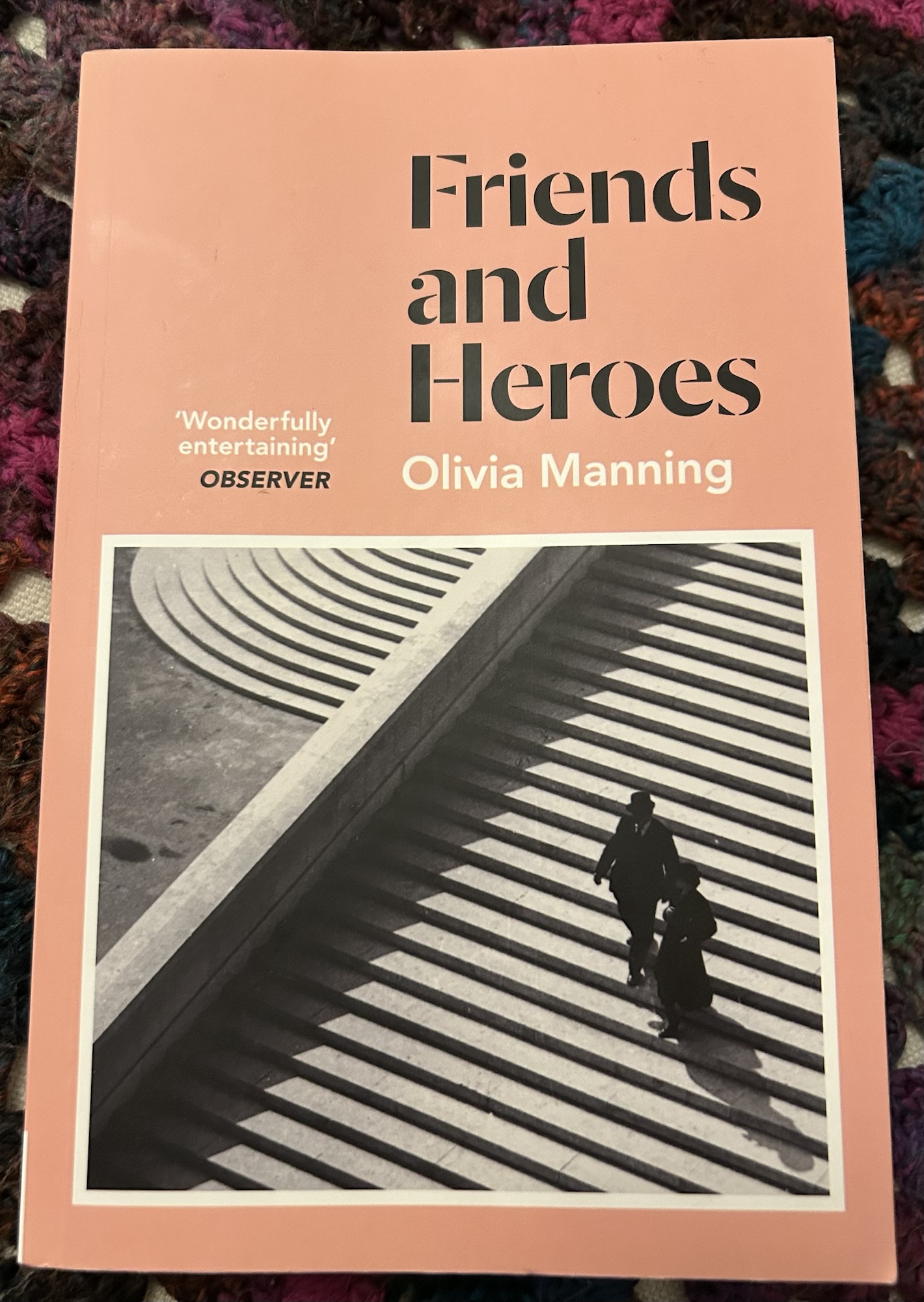
At the start of the novel, Harriet Pringle has left behind war-torn Bucharest and made it to Athens. She is anxiously waiting for her husband Guy to join her:
“She glanced about her, bewildered by her safety, unable to believe in a city so becalmed in security and comfort. Her nerves reacted still to the confusion of their last months in Romania.”
Guy does manage to escape and reach her, but as his work arrangements with the British Council were for Cairo, he finds himself somewhat adrift, compounded by old adversaries Lush and Dubedat conspiring to keep their positions of minor power in education, and Guy well away from it all. For relentless extrovert Guy, this is challenging:
“Throwing himself into one occupation or another, he had managed to keep anxiety on the periphery of consciousness; now, without employment, without friends, without money, he was trying to follow his old escape pattern. But there was no route open to him.”
The faultlines always so apparent in the Pringles’ marriage start to become real cracks in Friends and Heroes. Harriet needs intimacy and to be prioritised, Guy is not uncaring but he is entirely unable to provide either of these things:
“He loved her, but his love must be taken for granted. If she put it to the proof according to her needs, she found herself sacrificed to what he saw as a more important need: his need to be free to do what he wanted to do.”
Guy is also not so generous that he values other people for their differences. Alan Frenwen is a sweet, socially awkward man, who loves Greece and his little dog Diocletian. Guy disregards him as he cannot provide the political echo chamber and admiration Guy needs. Instead, he has an intense friendship with the generally unpleasant Ben Phipps, because they can slap each other on the back regarding their shared communist beliefs.
Manning is very good at portraying unlikeable characters. Three books in and I’m still not especially keen on either Guy or Harriet, or their circle. Yet they are so recognisable and believable, young and out of their depth personally and politically.
“This was a world in which only the ignorant could be happy.”
Even my favourite character, Prince Yaki, remains thoroughly reprehensible, forever sponging off people. Except he has finally sold his Hispano-Suiza and so for once has money:
“In funds, he had no need of friends. When he could buy his own food, he ate well and ate alone.”
Terrible! Yet at times he is a good friend to Harriet, and I do find him irrepressible despite his constant proclamations of being “poor Yaki”.
We spend time with this community as they wait to see if Greece will be pulled into the war, wondering if they should leave, and if so, where to go. The tension builds as the situation worsens in world politics and in the Pringle’s marriage; the first leading to soldiers swamping the city and a handsome one of these named Charles Warden threatening the second.
I had a sense in Friends and Heroes of Manning really growing in accomplishment as a writer. The interweaving of the Pringles marriage portrait alongside vivid descriptions of Greece and the growing threat of invasion is finely balanced. The characterisation of well-established figures becomes more complex, and there are two scenes in particular of true sadness, highlighting the human destruction both physically and spiritually during war.
“Pale and unhappy, he returned to his books, wanting to hear no more. Harriet pitied his disillusionment, but had no patience with it. Reality was not to be altered by an inability to recognise fact.”
Friends and Heroes builds to a long, tense final chapter as the Pringles try and decide how severe the threat is to them if they stay, and if they want to evacuate to Egypt how on earth they will even manage it. I thought it was brilliantly done and the Levant trilogy is absolutely on my 2027 reading list!
(I can see on Goodreads that some readers found the Balkan trilogy too long, which makes me think it is best to continue with spacing the books out a bit. Reading as Marcie suggested in alternate months meant I didn’t find them overlong at all. So now I just need to work out which months will be Levant months…)
“War was the time when mediocrities came to the top and better men must rot or die in the conflict.”
To end, of course Bowie, but I thought I’d be marginally less predictable and choose Seu Jorge’s version:


I enjoyed both the Balkan and Levant trilogies when they were reissued back in the late ’80s. They taught me a lot, too.
LikeLiked by 1 person
Yes, I’m learning a lot about the sequence of things which I realise now I hadn’t got straight at all. So pleased you enjoyed the Levant trilogy as I plan to read those soon!
LikeLiked by 1 person
I loved this book, despite the tragedies (the end!!!!!!!) And you can’t help but love Yaki, despite his foibles. I never did get to second trilogy – maybe one day!
LikeLiked by 1 person
The end!!!!! So sad. But I’m not deterred from the Levant trilogy thankfully. Great to hear you loved this one Kaggsy.
LikeLiked by 1 person
I feel shamed as I did really mean to have started the Balkan trilogy by now; I might still get to The Great Fortune before the year is out! You keep nudging me closer!
LikeLiked by 1 person
No shame to feel – so many books, so little time… I hope you enjoy The Great Fortune when you get to it!
LikeLike
I’m really glad you got so much out of reading this trilogy, and you’re right, Manning is so skilled at portraying unlikeable characters – and the undesirable sides of likeable ones, too!
LikeLiked by 1 person
I really did Jacqui, thank you for your encouragement! Her characterisation is excellent, I’m looking forward to seeing how it develops in the Levant trilogy.
LikeLike
Yes, thank you, Jacqui: it was on your post that we collided and decided to make a little schedule to read these ourselves at long last! And it really has felt just perfect having a month between each volume, just enough time to feel the weight of what was happening in their wartime reality, without feeling too overburdened as the conflict expands and extends for them.
I love all the quotes you’ve pulled here, but I found it was interesting that, when I checked my flags (I haven’t typed mine in yet for this volume), none of the passages I marked were the same. So maybe I will write up something after all. Mostly I’m excited about the next volume. Just name the next months: I’m in!
LikeLiked by 1 person
How interesting that you pulled very different quotes, I’d love to read your post if you do write it up! This is one of those where I ended up with loads of tabs sticking out at the end and had to decide which I’d use!
Hooray! I’m so glad you’d like to continue, it’s been a great buddy read and has definitely meant I’ve stayed organised to continue rather than letting it drift away from me, despite enjoying the books so much. How about January/March/May, would that suit you? I think your suggestion of alternate months has worked so well 😊
LikeLike
You’ve definitely kept me on track, and Jan/Mar/May sounds great! I’m so curious what will be her focus next.
LikeLiked by 1 person
Fantastic! I’m really looking forward to it.
LikeLike
I’m so glad you decided to do this – it’s been fun to follow along!
LikeLiked by 1 person
A pleasure. I’m looking forward to following your journey with it!
PS Just met up with my book group to discuss The Spoilt City, our most recent read – everyone else was driven mad by Yaki, much to my horror and surprise!
LikeLiked by 1 person
Poor Yaki (as he would say)! Definitely my favourite character across the trilogy.
LikeLike
Terrific, I haven’t started yet but it’s top of my list and I take your point about spacing the volumes out so I’ll make a plan for next year!
LikeLiked by 1 person
Great! I’ll look forward to hearing how you find them!
LikeLiked by 1 person